Articles
The five levels of industrial simulation: building the right model at the right time

Why You Might Not Be Ready… for the Model You’re Imagining
When talking about industrial simulation, many manufacturers immediately picture an extremely detailed digital model of their plant. They think of a digital twin replicating every machine, every operator, and every material movement.
The conclusion is then often the same:
"We’re not there yet."
Yet, simulation does not start with a digital twin.
Like any engineering project, it evolves progressively. The level of detail in a model depends above all on the decision to be made. A company looking to validate a plant expansion does not have the same needs as one trying to optimize its daily scheduling.
At Progima, we favor a progressive approach: developing the simplest model capable of answering today's question. This philosophy allows for quick results, limits data collection efforts, and scales the model only when it creates real value.
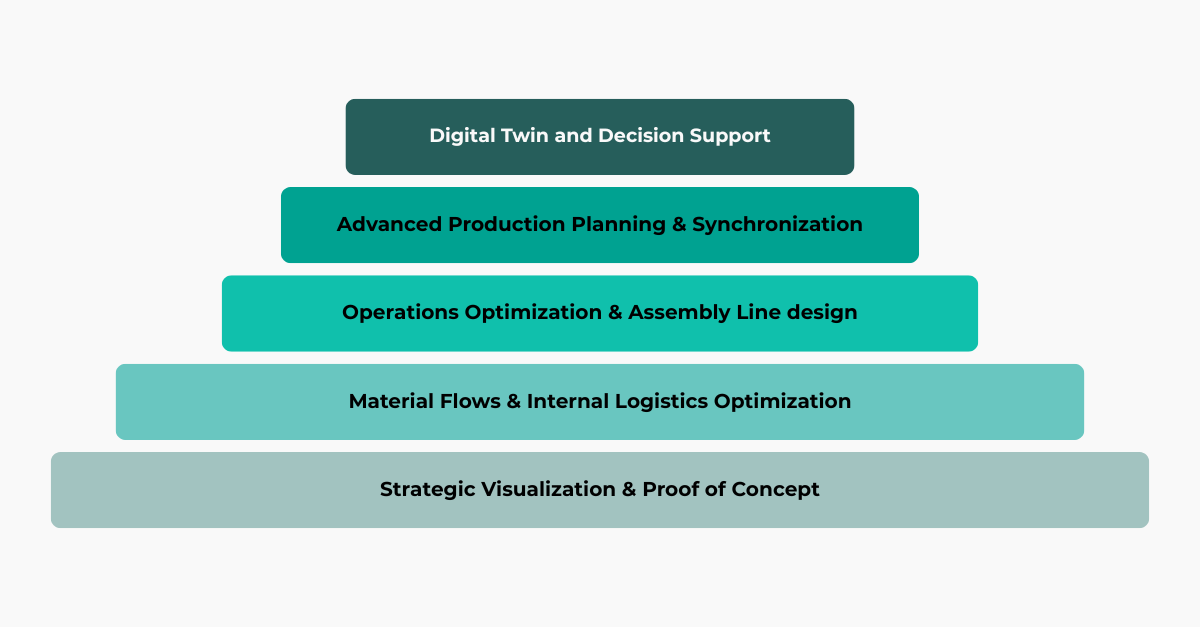
We distinguish five levels of simulation, each corresponding to a different stage in the maturity of an industrial project.
🌐 Level 1: Strategic Visualization and Concept Validation
Business question: Is our project viable?
Value: Reduce risks before investing.
Not all decisions require a detailed model. When a company considers an expansion, a new facility, a relocation, or an automation project, the first step is often to validate that the strategy is realistic.
The model then represents the main flows, major resources, and overall plant capacity. Its objective is not to replicate every operation, but to compare different scenarios to support an investment decision.
Typical applications:
• New plant (Greenfield)
• Facility expansion
• Plant layout redesign
• Automation
• Capacity validation
📦 Level 2: Optimization of Material Flows and Internal Logistics
Business question: How should materials flow?
Value: Optimize flows before investing in equipment.
Once the strategy is validated, material flows often become the main challenge. Even a high-performing production line can lose efficiency if products, pallets, or vehicles face internal bottlenecks.
The model allows teams to evaluate different logistics strategies, identify congestion areas, size buffers, and compare multiple scenarios prior to implementation.
Typical applications:
• AGVs (Automated Guided Vehicles)
• Forklifts
• Conveyor systems
• Buffers
• Warehousing
• Internal logistics
⚙️ Level 3: Operations Optimization and Assembly Line Design
Business question: What is the best production configuration?
Value: Improve productivity, capacity, and resource utilization.
When flows are under control, simulation can represent production operations with higher precision. Equipment, operators, cycle times, changeovers, and operational constraints are integrated into the model to identify true performance drivers.
Scenarios can be compared virtually before rollout, reducing the risks associated with improvement projects.
Typical applications:
• Line balancing
• Workforce sizing
• Capacity analysis
• Bottleneck identification
• Automation
🗓 Level 4: Advanced Production Planning and Synchronization
Business question: How do we produce efficiently despite variability?
Value: Move from local optimization to global optimization.
Even an optimized plant must deal with changing priorities, demand variability, resource constraints, and changeovers.
At this level, simulation becomes a planning support tool. It allows planners to compare different sequencing strategies, evaluate their impact on lead times, inventories, and resource utilization, and then select the best-performing scenario.
Typical applications:
• Sequencing
• Production planning
• Multi-line synchronization
• Product mix analysis
• Inventory management
🤖 Level 5: Digital Twin and Decision Support System
Business question: What is the best decision to make right now?
Value: Turn simulation into a real-time decision-making engine.
The digital twin represents the most advanced level of maturity. Connected to enterprise management systems (MES/ERP), it continuously evolves with live shop floor data.
It enables teams to quickly evaluate different scenarios before making a decision, whether responding to an equipment failure, a schedule change, or a shift in customer demand.
Simulation becomes a true operational management tool, supporting teams on a daily basis.
Typical applications:
• Real-time decision-making
• Predictive analytics
• What-if simulation
• Continuous improvement
• Dynamic production management
✅ An Approach That Evolves with Your Needs
Industrial simulation is not an "all or nothing" project. It is a journey that evolves with the company’s maturity.
An initial model can simply serve to validate an investment strategy. A few months later, that same model can be enriched to analyze flows, optimize operations, improve planning, or eventually become a digital twin connected to live production data.
The objective is not to build the most detailed model possible right from the start. It is to develop the level of simulation that brings the most value to the decision you need to make today.